The medical industrial complex in healthcare isn’t just a headline. It shows up in ordinary office visits—often in ways that feel completely reasonable in the moment.
Most clinicians are trying to help. Most patients are trying to do the right thing. And yet the system keeps nudging everyone toward more testing, more procedures, and more prescriptions—even when the benefit is small.
The quiet pressure behind “normal” care
A patient comes in with a familiar story: back pain after lifting something heavy. They’re scared—because pain feels like danger. Someone says, “Let’s get the MRI just to be safe.” It sounds responsible. It sounds thorough. It sounds like modern medicine at its best.
And then the scan finds something—because scans almost always do. A bulge. A tear. “Degenerative change.” Now the pain has a name, and the name has momentum. Next comes the referral. Then the injection. Then the repeat imaging. Then the procedure that’s “low risk.” Sometimes it helps. Sometimes it doesn’t. But the patient rarely leaves that path feeling calmer, stronger, or more in control.

That’s the medical-industrial complex at ground level. Not a cartoon villain. Not a secret room where people plot against you. Just a system that quietly rewards doing more—and calls it good care. That’s how “profits before patients” happens even when individual clinicians are trying to do right by you.
This post is about those everyday nudges: imaging “packages,” procedure cascades, quality bonuses, and ownership patterns that pull care in a predictable direction. We’ll also point you to a simple download—the Follow the Money: Visit Prep Guide—so you can keep decisions centered on you.
This isn’t about bad people. It’s about predictable incentives.
Most clinicians are not trying to “sell” you something. But they’re practicing inside a system that pays more for action than for restraint, and more for procedures than for listening. In that environment, the default plan becomes:
- test sooner
- refer faster
- treat the number
- escalate the intervention
- measure compliance, not outcomes that matter to the patient
In our podcast conversations, we keep returning to the same theme: the system is excellent at dramatic rescue—and much worse at thoughtful, relationship-based care. When that’s true, “more” starts to look like “better,” even when it isn’t.
Nudge #1: Imaging “packages” that feel like reassurance
Imaging can be lifesaving when it’s targeted and timely. But imaging is also one of the easiest places for the system to drift into overuse, because it offers something people crave: certainty.
The trouble is, the body is full of findings that sound alarming and often mean nothing. When an MRI becomes the first step instead of the right step, you can end up treating an image instead of a person.
Why it happens:
Imaging is fast to order, easy to justify, and often embedded in health system revenue streams. If a system owns the scanner, the scan is not just a clinical decision—it’s also a business decision, whether anyone says so out loud or not.
Patient-centered question:
“Will this scan change what we do next—and will that change improve my life?”

Nudge #2: The procedure “pathway” that becomes hard to step off

Procedures are rarely presented as a single decision. They’re often presented as a sequence:
- consult
- test
- “trial” intervention
- follow-up test
- escalation
Each step can be defensible. Each step can be billable. And once you’re on the pathway, saying “wait” can feel like you’re being irresponsible—when in fact, waiting is sometimes the most responsible choice in medicine.
Why it happens:
A system built to reward volume naturally creates downstream momentum. It’s not that anyone has to push you. The system already leans in that direction.
Patient-centered question:
“What’s the smallest next step that keeps me safe—without committing me to a cascade?”
Nudge #3: “Quality” bonuses that reward numbers over people
Quality measures were created with good intentions. But once you tie payment, rankings, or performance reviews to targets, you create a new kind of pressure. Blood pressure. A1c. LDL. Screening rates. Compliance metrics.
And then a subtle shift occurs: the metric becomes the mission.
We’ve both seen the result: patients on multiple medications to “hit a goal,” while dizziness, fatigue, falls, and loss of function are treated like acceptable collateral damage. The chart looks better. The person feels worse.
Why it happens:
Targets are easy to measure and easy to reward. Goals that matter to patients—sleep, function, stability, confidence, less fear—are harder to quantify. So the system often chooses what it can measure over what it should value.
Patient-centered question:
“Are we treating me, or treating the metric?”

Nudge #4: Ownership shapes referral gravity

Ownership doesn’t just affect billing. It shapes where you get sent.
When a health system owns hospitals, imaging centers, specialty practices, surgery centers, and infusion clinics, referrals naturally flow inward. Sometimes that coordination helps. Sometimes it quietly narrows your options and increases cost.
This is one of the least discussed realities of modern care: the referral loop is often also a revenue loop.
Why it happens:
Systems are built to keep services “in network,” “in house,” and “under the umbrella.” That can reduce friction—but it can also make it harder for patients to compare alternatives.
Patient-centered question:
“Do I have other options—and are they equally good at a lower cost?”
Nudge #5: Fear sells. And medicine is not immune.
Fear is a powerful fuel in healthcare. It can show up in headlines, in ads, in risk calculators, and in the well-meaning phrase: “We don’t want to miss anything.”
But medicine is full of tradeoffs. And a system that profits from more interventions has every reason to emphasize the danger of doing nothing, while minimizing the harms of doing something.
That’s why we keep coming back to absolute risk. What are the chances you benefit? What are the chances you’re harmed? What happens if you wait? What do you value most?
Why it happens:
Because fear accelerates decisions. And fast decisions are rarely patient-centered decisions.
Patient-centered question:
“What is my absolute risk—and how much does this intervention actually change it?”

What we’re really advocating is slower, clearer medicine
This is not an argument against testing. Or specialists. Or procedures. It’s an argument against automatic escalation—the idea that more medicine is always the safest medicine.
Sometimes the best next step is a test.
Sometimes it’s a medication.
Sometimes it’s a procedure.
And sometimes it’s the sentence we don’t hear enough in modern healthcare:
“Let’s wait. Let’s watch. Let’s decide together.”
That’s what patient-centered care sounds like inside a system built on throughput.
If you want something practical you can use at your next appointment, download our one-page guide: Follow the Money: Visit Prep Guide. It’s a short list of questions designed to keep decisions grounded in what matters to you—benefit, harm, alternatives, cost, and whether you’re being pulled into a cascade.
Download the guide, keep it on your phone, and use it whenever a “just to be safe” recommendation appears.
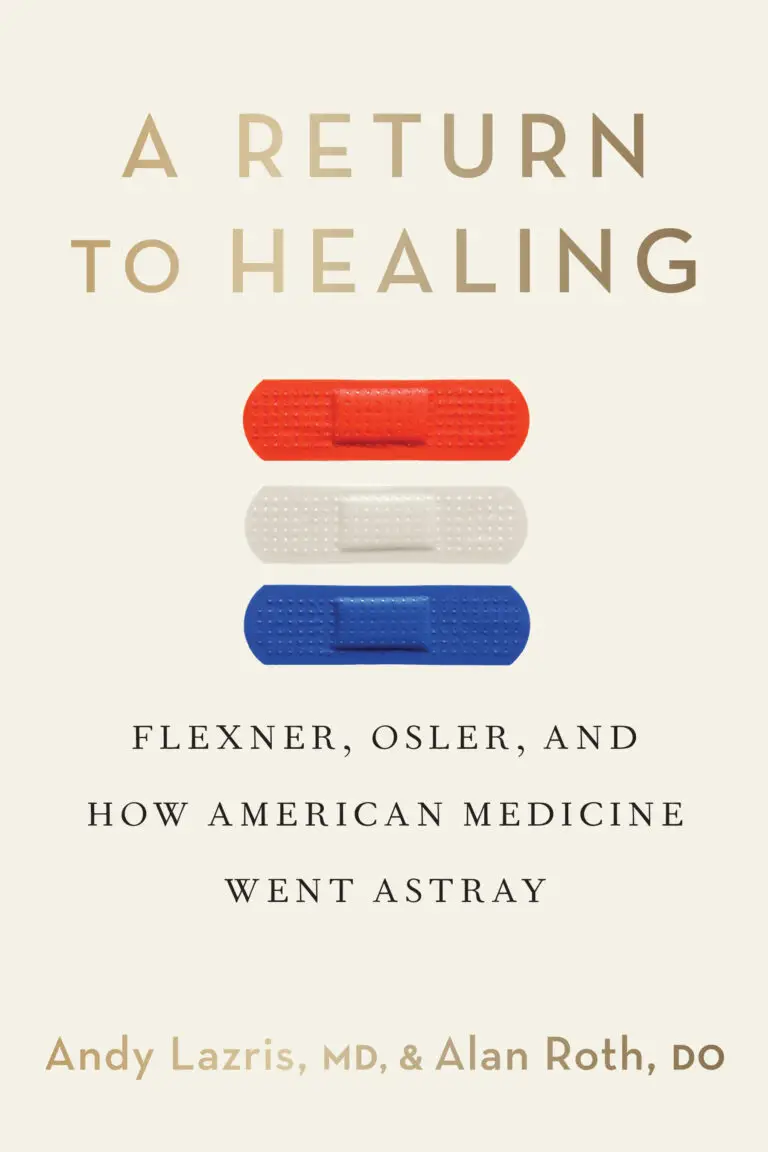
A Return to Healing & why this matters
In A Return to Healing, we argue that the deepest damage done by the medical-industrial complex isn’t only financial. It’s relational. When care becomes a conveyor belt of metrics and interventions, patients feel processed instead of known. Clinicians feel pressured instead of thoughtful. Everyone loses trust.
But the way back is not complicated: clarity, humility, and partnership. Decisions should be shared. Evidence should be interpreted, not weaponized. And the patient—not the system—should be the center of gravity.
Reviewer note
Written by Dr. Andy Lazris, MD. Medically reviewed by Dr. Alan Roth, D